A Public Brief April 2026
Australian criminal justice · Reform brief

There are 50,000 people in cages in Australia right now. Most of them did not get a fair trial.

The criminal-justice system that put them there cannot reliably distinguish the innocent from the guilty. The research proving it is thirty years old. This is a one-page brief on what the research actually says, and what three reforms would change it.

54.1% Accuracy with which trained officers detect lies — statistical coin-flip.
91% Of the behavioural cues used to judge credibility are empirically inverted.
12–30% Of DNA exonerations that involved a false confession.
80–120% Increase in suggestibility during pre-interrogation detention.
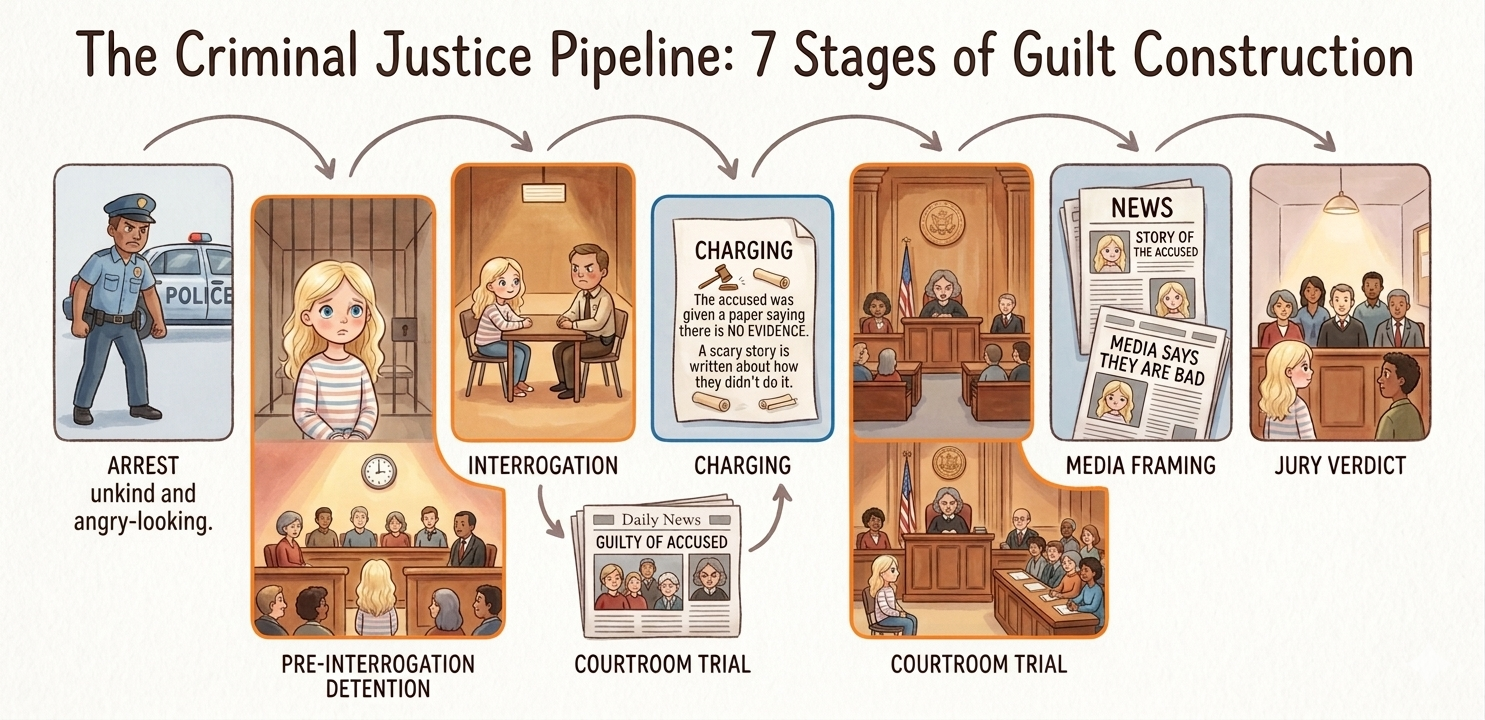
The Criminal Justice Pipeline — Seven Stages of Guilt Construction. A defendant is processed through arrest (by a visibly angry officer), pre-interrogation detention, interrogation, charging (a document stating there is no evidence but telling a scary story anyway), courtroom trial, media framing, jury verdict.
Figure 1 The seven-stage pipeline. Each stage produces outputs that the next stage treats as inputs. At no stage is this person is innocent a possible output. The charging document in this diagram is labelled honestly: "the accused was given a paper saying there is no evidence — a scary story is written about how they didn't do it."

Section 1The system does not find guilt. It builds it.

A criminal-justice system that worked would have one job: reliably distinguish the people who committed a crime from the people who did not. It is a simple-sounding job. Forty years of peer-reviewed research across four independent disciplines — psychology, linguistics, criminology, neuroscience — says the Australian (and wider common-law) system cannot do it.

What the system can do is produce an output labelled "guilty" from almost any person who enters it. That output is not a discovery. It is a construction. Each of the seven stages in Figure 1 takes a partial input — a complaint from a hostile neighbour, a 45-minute interview with a sleep-deprived suspect, a news headline, a strip-searched defendant on bail who flinches at the magistrate — and adds processing that moves the person closer to "convicted." No stage moves them closer to "cleared." The architecture is asymmetric by design.

This is not a partisan claim. It is the consensus of the empirical literature. The citations at the bottom of this page are the receipts.

54.1%
Accuracy of human lie-detection, including trained police, judges, and customs officers.
Bond & DePaulo, Psychological Bulletin (2006), meta-analysis of 206 studies, N ≈ 24,000. [1]
91%
Of behavioural cues humans use to judge credibility are either statistically invalid or point in the opposite direction.
DePaulo et al., Psychological Bulletin (2003); Vrij et al. (2019). [2]
22%
Of eyewitness memories altered by a single leading question from an interrogator.
Loftus & Palmer (1974); Loftus (2005). [3]
12–30%
Of DNA exonerations in which the wrongly-convicted person had confessed.
Kassin & Gudjonsson, Psychological Science in the Public Interest (2004); Innocence Project. [4]
80–120%
Increase in suggestibility above personal baseline during pre-interrogation detention — strip search, cell, cold, no clock, no lawyer.
Gudjonsson (2003), The Psychology of Interrogations and Confessions. [5]

Section 1.5In Australia, specifically.

The numbers above are global — meta-analyses pooled across the common-law world. Australia's specifics are worse in almost every dimension that matters, and the receipts are Australian government documents.

Indigenous over-incarceration. Aboriginal and Torres Strait Islander people are approximately 3.8% of the Australian population and approximately 33% of the adult prison population. Rate per 100,000: around 2,300 — higher than any other identified population on earth, including the Black imprisonment rate in the United States (Weatherburn & Holmes, 2017; ABS 2024). The Royal Commission into Aboriginal Deaths in Custody reported in 1991. 339 recommendations. Most not implemented. Over 500 Indigenous deaths in custody have occurred in the 34 years since.

Women's prisons. Independent inspectors have repeatedly reported that Western Australian women's remand facilities (notably Melaleuca Women's Prison) are not fit for purpose for the population they hold. The WA Office of the Inspector of Custodial Services — a statutory body — has recorded concerns about overcrowding, inadequate medical care, and conditions for women with complex trauma histories. Their reports are public record.

State-by-state. Northern Territory's imprisonment rate is approximately 1,050 per 100,000 (eleven times the Northern European average). Queensland, WA, and NSW all incarcerate at rates that would be politically impossible to defend if the headlines reflected the numbers. They don't, so they aren't.

This is not abstract. These are specific, documented, government-audited facilities holding specific people under conditions their own inspectors describe as inadequate — while the state that runs them tells you the system works.

Section 1.6Laboratory rats have more legal protections than prisoners. This is not a metaphor.

Before a single rat enters a cage in any Australian research facility, the following must occur — by law:

Now the human prisoner. Australian custody law requires:

A rat gets a community member on the ethics committee. A human does not.

Section 2In the interview room, the system has a guilt-consistent reading of everything you could possibly do.

There is nothing you can say. Not because the officers are evil. Not because there is a conspiracy. Because the system is designed — architecturally, procedurally, from the ground up — so that no behaviour you exhibit can be interpreted as evidence that you are innocent.

For every possible behaviour, the system has a guilt-consistent interpretation ready.

There is no box on the form for this person is telling the truth. The form doesn't have that box.
This is not a failure of the system. This is the system.
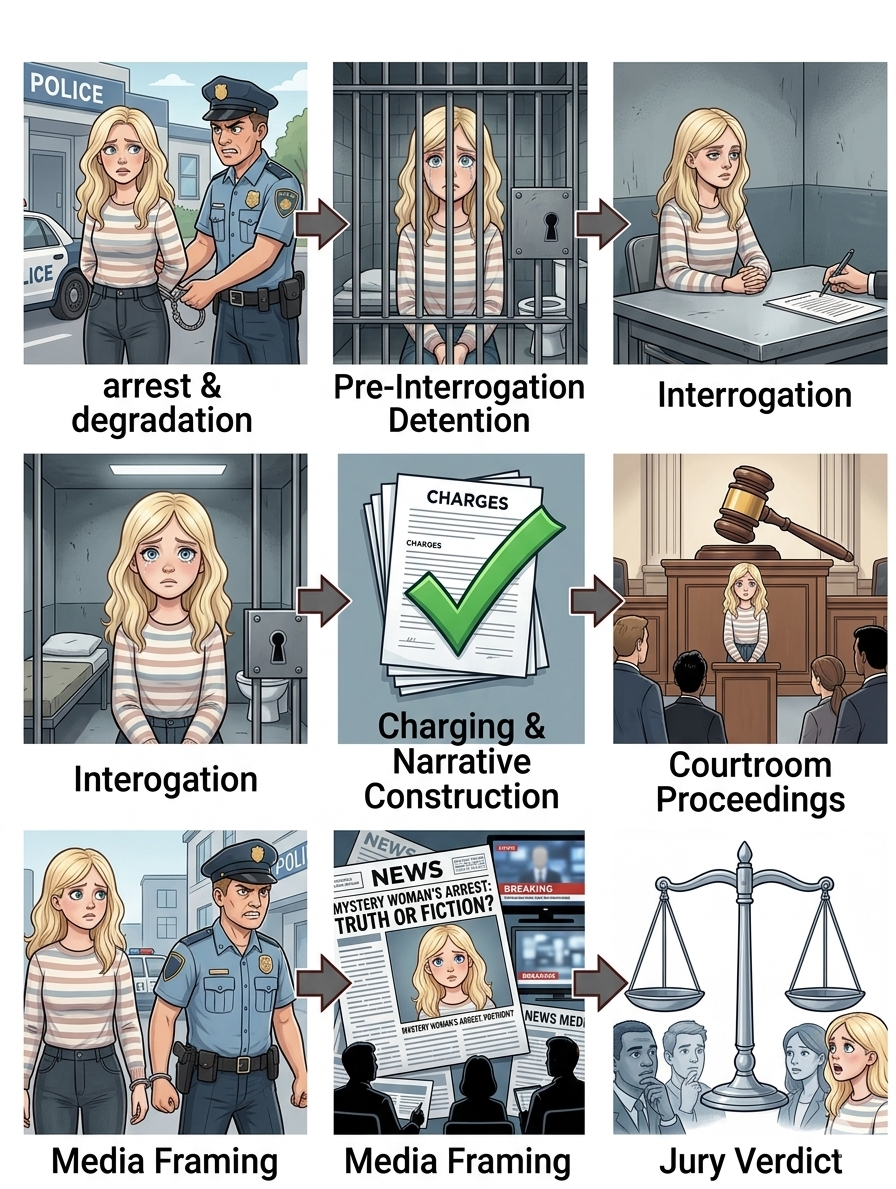
The Criminal Justice Pipeline annotated with red labels: ARREST is marked KIDNAPPED, PRE-INTERROGATION DETENTION is marked IMPRISONED, CHARGING is marked INNOCENT, and the headline GUILT CONSTRUCTION is marked FAKE.
Figure 2 The same pipeline labelled honestly. Each stage has a stated purpose and an architectural function; the two rarely match. The arrest, framed as "apprehension of a suspect," is a body-in-a-cage operation. The charging, framed as "due process," is the written construction of a narrative around evidence that doesn't yet cohere. Calling these things by their working names is the beginning of reform.

Section 3Three reforms. Each is already operating, somewhere, with independent evaluation showing it works.

The case against the existing architecture is not the case for no system. It is the case for the system to be rebuilt around features that already exist, elsewhere, and have been measured.
01

Replace the Reid Technique with PEACE interviewing.

The Reid Technique is the nine-step, confrontational interrogation method trained across most of the common-law world. It is designed to elicit confessions. It elicits them from innocent people at a measurable rate. England and Wales replaced it with PEACE in 1992 — information-gathering over confession-seeking — and independently-evaluated false-confession rates dropped. Australia has no equivalent national standard. This is a training change, not a legal one. Cost: low.

02

Mandate electronic audio + video recording of all custody and interview.

Already the standard in the UK under PACE 1984, most of Canada, many US states. Reduces false-confession rates, reduces allegations of coercion, produces a reviewable record. Every phone has a camera. The technical barrier is zero. The political barrier is that it produces evidence police cannot later deny. Cost: low.

03

Install a mandatory independent layperson in custody oversight.

The Animal Welfare Act (1966) and Australian animal-ethics committees require a community member — not a veterinarian, not a researcher, not a staffer — to sit on the review body for any facility housing lab animals. The requirement does not exist for human custody. A Federal Prison Oversight Act (US 2024) created the first independent federal prison inspection body. Thirty-one of fifty US states still have no independent prison oversight. Australia has patchy state-level coverage. Legislative fix.

Fifty thousand Australians are processed through an architecture that cannot distinguish them from each other.
The system is not broken. It is doing what it was built to do.

These organisations are doing this work right now. Support them.

What to do right now · Ninety seconds

You can do one thing. Send this to three people by name.

Not retweet it. Not like it. Send it to three people you know — three individual messages, three names — who haven't heard this yet. That's the mechanism. Every reader, three people. One page moves across a country in two weeks.

You're not a minority of people who care. You're a majority who couldn't see each other. Three messages is how the majority starts counting itself.

you
3
9
27
81
243

Seven rounds of three: 2,187 people read this because you sent three messages. Thirteen rounds: every Australian adult.

Sources — every number above comes from a peer-reviewed or government source. Check the receipts.

  1. Bond, C. F., & DePaulo, B. M. (2006). Accuracy of deception judgments. Personality and Social Psychology Review, 10(3), 214–234. Meta-analysis of 206 studies, N ≈ 24,000. pubmed.ncbi.nlm.nih.gov/16859438
  2. DePaulo, B. M., Lindsay, J. J., Malone, B. E., Muhlenbruck, L., Charlton, K., & Cooper, H. (2003). Cues to deception. Psychological Bulletin, 129(1), 74–118. pubmed.ncbi.nlm.nih.gov/12555795
  3. Loftus, E. F., & Palmer, J. C. (1974). Reconstruction of automobile destruction. Journal of Verbal Learning and Verbal Behavior, 13(5), 585–589. Loftus, E. F. (2005). Planting misinformation in the human mind. Learning & Memory, 12(4), 361–366.
  4. Kassin, S. M., & Gudjonsson, G. H. (2004). The psychology of confessions: A review of the literature and issues. Psychological Science in the Public Interest, 5(2), 33–67. Innocence Project exoneration data. innocenceproject.org
  5. Gudjonsson, G. H. (2003). The Psychology of Interrogations and Confessions: A Handbook. Wiley. ISBN 978-0470844618.
  6. Simons, D. J., & Chabris, C. F. (1999). Gorillas in our midst: Sustained inattentional blindness for dynamic events. Perception, 28(9), 1059–1074. (The Invisible Gorilla experiment.) pubmed.ncbi.nlm.nih.gov/10694957
  7. Australian Bureau of Statistics (2024). Prisoners in Australia. Approximately 42,000 adults in prison on any given day; +13,000+ under community supervision and in youth detention. abs.gov.au
  8. Australian Law Reform Commission (2017). Pathways to Justice — Inquiry into the Incarceration Rate of Aboriginal and Torres Strait Islander Peoples. Report 133. alrc.gov.au
  9. Royal Commission into Aboriginal Deaths in Custody (1991). National Report, 5 volumes. 339 recommendations. austlii.edu.au
  10. Clarke, C., & Milne, R. (2001). A National Evaluation of the PEACE Investigative Interviewing Course. Home Office, UK. Independent evaluation showing PEACE produces more reliable evidence than Reid-style interrogation.
  11. National Registry of Exonerations (ongoing). University of Michigan Law School. 3,300+ documented exonerations since 1989. law.umich.edu/special/exoneration