Australian criminal justice · Reform brief
There are 50,000 people in cages in Australia right now. Most of them did not get a fair trial.
The criminal-justice system that put them there cannot reliably distinguish the innocent from the guilty. The research proving it is thirty years old. This is a one-page brief on what the research actually says, and what three reforms would change it.
54.1% Accuracy with which trained officers detect lies — statistical coin-flip.
91% Of the behavioural cues used to judge credibility are empirically inverted.
12–30% Of DNA exonerations that involved a false confession.
80–120% Increase in suggestibility during pre-interrogation detention.
A criminal-justice system that worked would have one job: reliably distinguish the people who committed a crime from the people who did not. It is a simple-sounding job. Forty years of peer-reviewed research across four independent disciplines — psychology, linguistics, criminology, neuroscience — says the Australian (and wider common-law) system cannot do it.
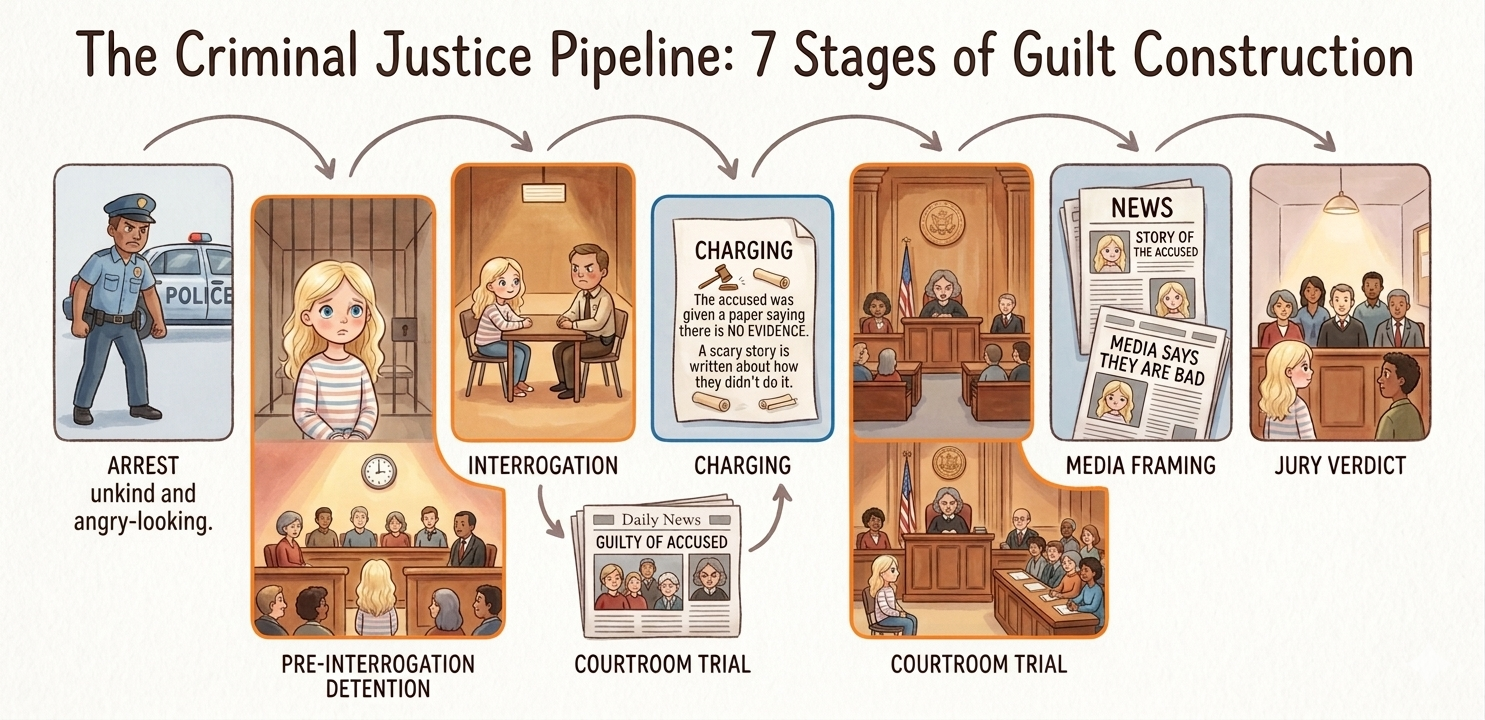
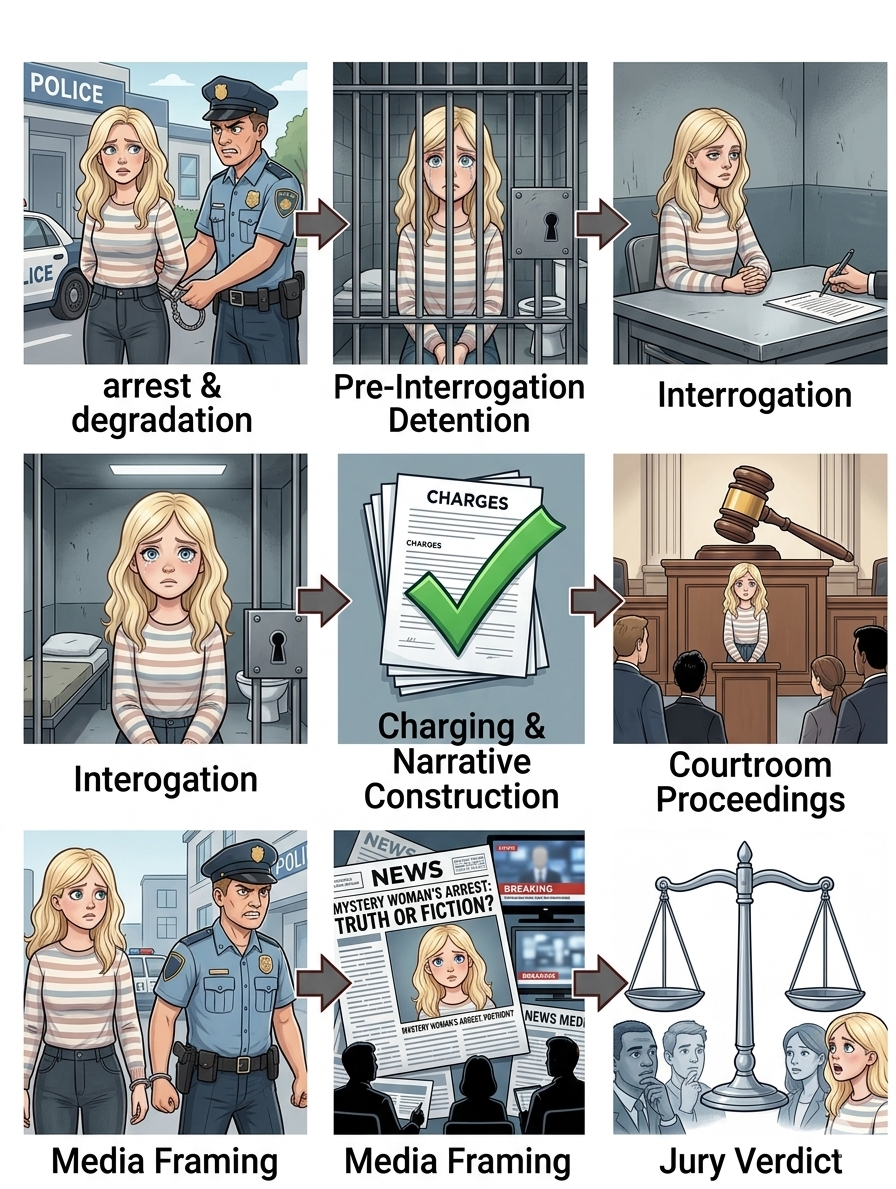
What the system can do is produce an output labelled "guilty" from almost any person who enters it. That output is not a discovery. It is a construction. Each of the seven stages in Figure 1 takes a partial input — a complaint from a hostile neighbour, a 45-minute interview with a sleep-deprived suspect, a news headline, a strip-searched defendant on bail who flinches at the magistrate — and adds processing that moves the person closer to "convicted." No stage moves them closer to "cleared." The architecture is asymmetric by design.
This is not a partisan claim. It is the consensus of the empirical literature. The citations at the bottom of this page are the receipts.
The numbers above are global — meta-analyses pooled across the common-law world. Australia's specifics are worse in almost every dimension that matters, and the receipts are Australian government documents.
Indigenous over-incarceration. Aboriginal and Torres Strait Islander people are approximately 3.8% of the Australian population and approximately 33% of the adult prison population. Rate per 100,000: around 2,300 — higher than any other identified population on earth, including the Black imprisonment rate in the United States (Weatherburn & Holmes, 2017; ABS 2024). The Royal Commission into Aboriginal Deaths in Custody reported in 1991. 339 recommendations. Most not implemented. Over 500 Indigenous deaths in custody have occurred in the 34 years since.
Women's prisons. Independent inspectors have repeatedly reported that Western Australian women's remand facilities (notably Melaleuca Women's Prison) are not fit for purpose for the population they hold. The WA Office of the Inspector of Custodial Services — a statutory body — has recorded concerns about overcrowding, inadequate medical care, and conditions for women with complex trauma histories. Their reports are public record.
State-by-state. Northern Territory's imprisonment rate is approximately 1,050 per 100,000 (eleven times the Northern European average). Queensland, WA, and NSW all incarcerate at rates that would be politically impossible to defend if the headlines reflected the numbers. They don't, so they aren't.
This is not abstract. These are specific, documented, government-audited facilities holding specific people under conditions their own inspectors describe as inadequate — while the state that runs them tells you the system works.
Before a single rat enters a cage in any Australian research facility, the following must occur — by law:
- An animal ethics committee (AEC) must review and approve a written protocol, including the "Three Rs" — Replace, Reduce, Refine. Mandated by the NHMRC Australian Code for the Care and Use of Animals for Scientific Purposes.
- The committee must include at least one independent community member with no institutional or veterinary affiliation — a layperson whose job is to ask "is this suffering justified?" on behalf of the public.
- The facility must be physically inspected every six months with written reports and mandatory corrective action.
- Minimum floor space is specified per animal by body weight. Environmental enrichment is mandatory. Social housing is the default; isolation requires written justification.
- There must be a veterinarian on call and a humane endpoint — the experiment has to end.
Now the human prisoner. Australian custody law requires:
- A judge (or custody officer). That's the whole pre-confinement review.
- No independent community member sitting on any oversight body for the custody conditions of the person being held.
- Inspection varies by state; most facilities are inspected rarely, some almost never. No comparable statutory six-month cycle.
- No mandated minimum space standards with teeth. Overcrowding is documented. Environmental enrichment — not on the statute.
- Solitary ("separate confinement") is used routinely, frequently without written justification.
- Medical care varies wildly; deaths in custody from untreated medical conditions are ongoing and documented.
- No "is this suffering justified?" question exists in the architecture. Not at charging, not during incarceration, not at release.
A rat gets a community member on the ethics committee. A human does not.
There is nothing you can say. Not because the officers are evil. Not because there is a conspiracy. Because the system is designed — architecturally, procedurally, from the ground up — so that no behaviour you exhibit can be interpreted as evidence that you are innocent.
The case against the existing architecture is not the case for no system. It is the case for the system to be rebuilt around features that already exist, elsewhere, and have been measured.